Išgyvenamumas pagal amžių
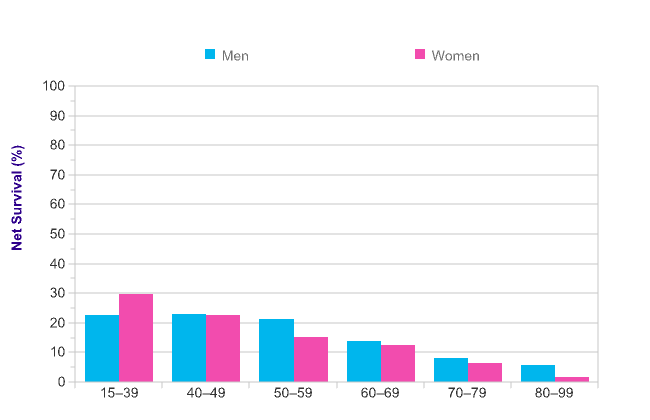
Išgyvenamumas pagal paplitimą
Skaičiai pagrįsti sergančiųjų kepenų vėžiu tarp 2011m. ir 2017m. Atminkite, kad išgyvenamumas ir rodikliai yra apytikriai ir paremti ankstesniais sirgusių žmonių rezultatais, jie nepasako kas bus konkrečiu jūsų atveju. Šie statistiniai duomenys gali būti painūs. Jus gydantis onkologas yra išsamiau susipažinęs su Jūsų situacija.
| Išplitimo stadija | 5 metų išgyvenamumas |
| Vietinis | 35% |
| Netolimas | 12% |
| Tolimas | 3% |
| Bendras | 20% |
Metastazės
Išgyvenamumas priklauso nuo daugelio veiksnių. Viena iš tokio mažo išgyvenamumo priežasčių yra ta, kad daugelis žmonių, sergančių kepenų vėžiu, taip pat turi gretutinių sveikatos sutrikimų, tokių kaip kepenų cirozė. Ar išgydomas kepenų vėžys, gali skirtis priklausomai nuo to, kokios ir kur yra kepenų vėžio metastazės.
Jei kepenų vėžys neturi metastazių, 5 metų išgyvenamumas yra 28%. Jei metastazės kepenyse ir į netoliese esančius organus, 5 metų išgyvenamumas yra 7%. Kai kepenų vėžys yra išplitęs į toliau esančius organus ar audinius, išgyvenamumas yra tik 2 metai.
Išgyvenamumas dar labai priklauso nuo taikomų gydymo būdų. Kepenų vėžio, kurį galima pašalinti chirurginiu būdu (išpjauti), prognozė per 5 metus padidėja daugiau nei 50%. Kai liga randama ankstyviausiose stadijose ir persodinamos kepenys, 5 metų išgyvenamumas gali siekti 70%.
Ką galiu padaryti kovoje su kepenų vėžiu
Alkoholis yra toksiškas kepenų ląstelėms, todėl jo vartojimas gali pagreitinti kepenų pažeidimą, taip sukeldamas mirtinas pasekmes. Alkoholio reikės atsisakyti [2].
Metimas rūkyti tiesiogiai įtakoja (ilgina) išgyvenimo laiką [3]
Išgyvenamumas taip pat gali priklausyti nuo saldumo. Fruktozė (vaisiai, sultys, saldėsiai) yra kepenims toksiški [4][5]. Vitaminus ir mineralus reikės gauti iš daržovių, žuvies ir kiaušinių.
Grybai tūkstančius metų naudojami kaip vaistai dėl neprilygstamos farmakologinės įvairovės ir veikimo principų. Lentinan iš Lentinus Edodes medicininio grybo yra nuodugniausiai ištirta ir dokumentuota prieš-vėžinė medžiaga labiausiai žinoma dėl imunitetą skatinančių savybių (citokinų, makrofagų ir kt. išskyrimo) [6].
Šis tyrimas[7] nustatė, kad lentinan slopina kepenų vėžį, net „ …turi reikšmingą sinergetinį priešvėžinį poveikį…“ naudojant kartu su chemoterapija. Be to, kepenų vėžiu sergantiems pacientams ilgai vartojantiems lentinan gyvenimo trukmė reikšmingai ilgėja [8].
Naudojami tik vandens pagrindo polisacharidų ekstraktai. Dar būna etanolio (alkoholio) pagrindo ekstraktai, šis ekstrakto būdas yra pigesnis ir greitesnis, todėl neišgaunamos mums reikalingos medžiagos.
Kepenys atlieka centrinį vaidmenį organizmo detoksikacijoje ir imunitete. Koncentruota kelių grybų polisacharidų ekstraktų formulė gali padėti palaikyti imuninę sistemą ir pagerinti gyvenimo kokybę gydymo metu.
- Kawarada Y et al. Significance of multidisciplinary therapy for hepatocellular carcinoma. Cancer chemotherapy and pharmacology. 1992. PubMed
- Zou Y et al. A polysaccharide from mushroom Huaier retards human hepatocellular carcinoma growth, angiogenesis, and metastasis in nude mice. Tumour biology : the journal of the International Society for Oncodevelopmental Biology and Medicine. 2015. PubMed
- Khinsar KH et al. Anti-tumor effect of polysaccharide from Pleurotus ostreatus on H22 mouse Hepatoma ascites in-vivo and hepatocellular carcinoma in-vitro model. AMB Express. 2021. PubMed
- Li GL et al. The anti-hepatocellular carcinoma effects of polysaccharides from Ganoderma lucidum by regulating macrophage polarization via the MAPK/NF-κB signaling pathway. Food & function. 2023. PubMed
- Yang P et al. Clinical application of a combination therapy of lentinan, multi-electrode RFA and TACE in HCC. Advances in therapy. 2008. PubMed
- Yuan Y et al. TACE-HAIC combined with targeted therapy and immunotherapy versus TACE alone for hepatocellular carcinoma with portal vein tumour thrombus: a propensity score matching study. International journal of surgery (London, England). 2023. PubMed
- Maataoui A et al. Transarterial chemoembolization alone and in combination with other therapies: a comparative study in an animal HCC model. European radiology. 2005. PubMed
- Guo N et al. Transcatheter hepatic arterial chemoembolization plus cinobufotalin injection adjuvant therapy for advanced hepatocellular carcinoma: a meta-analysis of 27 trials involving 2,079 patients. OncoTargets and therapy. 2018. PubMed
- Yang Y et al. Compound kushen injection relieves tumor-associated macrophage-mediated immunosuppression through TNFR1 and sensitizes hepatocellular carcinoma to sorafenib. Journal for immunotherapy of cancer. 2020. PubMed
- Wang C et al. Astragali radix - Curcumae rhizoma herb pair enhances Sorafenib's efficacy by inducing ferroptosis and activates Th1 cell immune response synergistically against hepatocellular carcinoma. Phytomedicine : international journal of phytotherapy and phytopharmacology. 2025. PubMed
- Zhang QB et al. Suppression of natural killer cells by sorafenib contributes to prometastatic effects in hepatocellular carcinoma. PloS one. 2013. PubMed
- Sun Q et al. Targeting NAD(+) metabolism of hepatocellular carcinoma cells by lenvatinib promotes M2 macrophages reverse polarization, suppressing the HCC progression. Hepatology international. 2023. PubMed
- Mani SKK et al. Hepatitis B Virus-Associated Hepatocellular Carcinoma and Hepatic Cancer Stem Cells. Genes. 2018. PubMed
- Meng Y et al. Hepatitis B Virus-Mediated m6A Demethylation Increases Hepatocellular Carcinoma Stemness and Immune Escape. Molecular cancer research : MCR. 2024. PubMed
- Ortega-Prieto AM et al. Immune Evasion Strategies during Chronic Hepatitis B and C Virus Infection. Vaccines. 2017. PubMed
- Chisari FV et al. Hepatitis B virus immunopathology. Springer seminars in immunopathology. 1995. PubMed
- Meunier L et al. Chemotherapy-associated steatohepatitis. Annals of hepatology. 2020. PubMed
- Farrell GC Drugs and steatohepatitis. Seminars in liver disease. 2002. PubMed
- Huang DQ et al. Global epidemiology of NAFLD-related HCC: trends, predictions, risk factors and prevention. Nature reviews. Gastroenterology & hepatology. 2021. PubMed
- Llovet JM et al. Nonalcoholic steatohepatitis-related hepatocellular carcinoma: pathogenesis and treatment. Nature reviews. Gastroenterology & hepatology. 2023. PubMed
- Thomas SK et al. Kupffer cells prevent pancreatic ductal adenocarcinoma metastasis to the liver in mice. Nature communications. 2023. PubMed
- Pereira FE et al. Kupffer cell activation with BCG. Corynebacterium parvum or zymosan protects against acute liver injury induced by carbon tetrachloride in rats. Arquivos de gastroenterologia. 1997. PubMed
- Armbrust T et al. Functional characterization of two different Kupffer cell populations of normal rat liver. Journal of hepatology. 1996. PubMed
- Youssef J et al. Activated Kupffer cells attenuate the liver response to the peroxisome proliferator perfluorooctanoic acid. Molecular and cellular biochemistry. 1997. PubMed
- Lau HC et al. Gut microbiome in metabolic dysfunction-associated steatotic liver disease and associated hepatocellular carcinoma. Nature reviews. Gastroenterology & hepatology. 2025. PubMed
- Yu LX et al. The gut microbiome and liver cancer: mechanisms and clinical translation. Nature reviews. Gastroenterology & hepatology. 2017. PubMed
- Jiang JW et al. Gut microbial dysbiosis associates hepatocellular carcinoma via the gut-liver axis. Hepatobiliary & pancreatic diseases international : HBPD INT. 2019. PubMed
- Ahmad MF et al. Ganoderma lucidum: Novel Insight into Hepatoprotective Potential with Mechanisms of Action. Nutrients. 2023. PubMed
- Bahmani M et al. Silybum marianum: Beyond Hepatoprotection. Journal of evidence-based complementary & alternative medicine. 2015. PubMed
- Lu X et al. Pretransplant immunotherapy increases acute rejection yet improves survival outcome of HCC patients with MVI post-liver transplantation. Cancer immunology, immunotherapy : CII. 2024. PubMed
- Rezaee-Zavareh MS et al. Impact of pre-transplant immune checkpoint inhibitor use on post-transplant outcomes in HCC: A systematic review and individual patient data meta-analysis. Journal of hepatology. 2025. PubMed
- Ersan V et al. The Timing of Liver Transplantation Following Downstaging: Wait of Not to Wait?. Journal of gastrointestinal cancer. 2020. PubMed
- Hong G et al. Safety and Therapeutic Outcomes of Adjuvant Immunotherapy With Autologous Cytokine-induced Killer Cells for Patients With Hepatocellular Carcinoma Beyond Milan Criteria After Liver Transplantation. Transplantation. 2025. PubMed
- Leuchte K et al. Microwave ablation enhances tumor-specific immune response in patients with hepatocellular carcinoma. Cancer immunology, immunotherapy : CII. 2021. PubMed
- Lei Y et al. COX-2/PGE(2) axis blockade with celecoxib enhances anti-PD-1 efficacy by activating natural killer cells for residual hepatocellular carcinoma after radiofrequency ablation. Journal of experimental & clinical cancer research : CR. 2025. PubMed
- Qian L et al. Potent induction of antitumor immunity by combining cryo-thermal ablation with immune checkpoint inhibitors in hepatocellular carcinoma. Liver international : official journal of the International Association for the Study of the Liver. 2024. PubMed
- Xu X et al. Activation of Anti-tumor Immune Response by Ablation of HCC with Nanosecond Pulsed Electric Field. Journal of clinical and translational hepatology. 2018. PubMed
- Li J et al. Astaxanthin Inhibits Proliferation and Induces Apoptosis of Human Hepatocellular Carcinoma Cells via Inhibition of Nf-Κb P65 and Wnt/Β-Catenin in Vitro. Marine drugs. 2015. PubMed
- Laderian A et al. Hepatoprotective effect of astaxanthin against cholestasis liver fibrosis induced by bile duct ligation in adult Wistar rats. Journal of biochemical and molecular toxicology. 2024. PubMed
- Takada T et al. [Case of hepatocellular carcinoma with a marked reduction in the tumor size induced by PSK administration alone]. Gan to kagaku ryoho. Cancer & chemotherapy. 1983. PubMed
- Hara Y et al. [Disappearance of lung metastases from hepatocellular carcinoma following PSK administration]. Rinsho hoshasen. Clinical radiography. 1988. PubMed
- You J et al. Lentinan induces apoptosis of mouse hepatocellular carcinoma cells through the EGR1/PTEN/AKT signaling axis. Oncology reports. 2023. PubMed
- Wang Z et al. Apaf1 nanoLuc biosensors identified lentinan as a potent synergizer of cisplatin in targeting hepatocellular carcinoma cells. Biochemical and biophysical research communications. 2021. PubMed
- Wang Y et al. Effects of tumor-specific antigen induced by lentinan on murine H22 hepatocellular carcinoma immunoprophylaxis. European review for medical and pharmacological sciences. 2015. PubMed
- Isoda N et al. Clinical efficacy of superfine dispersed lentinan (beta-1,3-glucan) in patients with hepatocellular carcinoma. Hepato-gastroenterology. 2009. PubMed
- Wang H et al. Efficacy of biological response modifier lentinan with chemotherapy for advanced cancer: a meta-analysis. Cancer medicine. 2017. PubMed
- Oba K et al. Efficacy of adjuvant immunochemotherapy with polysaccharide K for patients with curative resections of gastric cancer. Cancer immunology, immunotherapy : CII. 2007. PubMed
- Cheng SC et al. mTOR- and HIF-1α-mediated aerobic glycolysis as metabolic basis for trained immunity. Science (New York, N.Y.). 2014. PubMed
- Kidd P Astaxanthin, cell membrane nutrient with diverse clinical benefits and anti-aging potential. Alternative medicine review : a journal of clinical therapeutic. 2011. PubMed
- Wang Y et al. Systematic review and meta-analysis on the efficacy and safety of Injectable Lentinan combined with chemotherapy in the treatment of gastric cancer. Phytomedicine : international journal of phytotherapy and phytopharmacology. 2024. PubMed