Kas yra kasos vėžys
Kasos vėžys yra navikas, randamas bet kurioje kasos dalyje. Vėžys prasideda kai ląstelės pradeda nekontroliuojamai daugintis. Norėdami sužinoti kodėl prasideda ir plinta vėžys žr. Kas yra vėžys.
Kasos adenokarcinoma yra dažniausias kasos vėžio tipas. Kasa gamina hormonus ir enzimus, kurie padeda virškinti maistą ir, tarp kitų funkcijų, reguliuoja cukraus lygį kraujyje.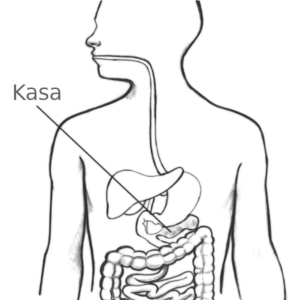
Simptomai
Kasos vėžys dažnai nerodo simptomų, kol nepasiekia vėlyvesnės stadijos, todėl nėra ankstyvų kasos vėžio požymių.
Dažniausi jau susiformavusio vėžio simptomai:- Apetito stoka
- Svorio mažėjimas
- Pilvo arba nugaros skausmas
- Kraujo krešuliai
- Pageltusios akys
- Depresija
Kai vėžys plečiasi, simptomai ryškėja, gali atsirasti naujų simptomų.
Ar paveldėjau?
Tik iki 1 iš 10 kasos vėžio atvejų gali būti paveldėti. Visi kiti 90% kasos vėžio atvejų yra įgyti. Tai gyvenimo metu įvykstančios mutacijos, o ne paveldimos mutacijos. Šios DNR mutacijos nėra perduodamos iš tėvų vaikams[1].
Kodėl sergame?
Jūsų kontroliuojamos priežastys:
- Cukrus, saldinti gėrimai ir saldumynai [2]
- Rūkymas[3]
- Alkoholis[4]
- Pesticidai[5]
- Viršsvoris[3]
- Chemikalai aplinkoje[6]
- Kadmis[7]
Stadijos
Aptikus kasos vėžį, atliekami papildomi tyrimai, kad įvertinti vėžio paplitimo laipsnį.
Nustačius kasos vėžio diagnozę, onkologas, pagal tyrimo rezultatus paskirs kasos vėžio stadiją:
1 stadija: kasos vėžys yra tik kasoje. 2 stadija: kasos vėžys išplitęs į netoliese esančius audinius ar limfmazgius. 3 stadija: kasos vėžys išplito į pagrindines kraujagysles ir limfmazgius. 4 stadija: kasos vėžys išplito į kitus organus, pavyzdžiui kepenis.
Kasos vėžio gyvenimo trukmė labai priklauso nuo paplitimo, parinkto gydymo ir paciento būklės.
Gydymas
Kasos vėžio gydymas ir išgyvenamumas priklauso nuo vėžio stadijos. Gydymo tikslas yra naikinti vėžines ląsteles ir užkirsti kelią ligos plitimui. Dažniausiai pasitaikančios komplikacijos gydant kasos vėžį: svorio kritimas, vidurių užkietėjimas, pilvo skausmas ir kepenų nepakankamumas.
Operacija
Vėžio stadija ir vieta nulemia ar gydant kasos vėžį bus atliekama operacija.
Operacija gali pašalinti pirminį naviką, tačiau nepašalins vėžio, išplitusio kitose kūno dalyse. Dėl šios priežasties operacija gali būti netinkama žmonėms, kuriems nustatytas pažengusios stadijos kasos vėžys.
Spindulinė terapija
Vėžiui išplitus už kasos ribų, gali būti paskirta spindulinė terapija. Spindulinė terapija naudoja rentgeno spindulių ir kitą švitinimą, kad sunaikintų vėžines ląsteles.
Chemoterapija
Kai kuriais atvejais su chemoterapija onkologas gali skirti ir kitus gydymo būdus.
Ką papildomai galiu padaryti kovoje su kasos vėžiu?
Taigi, jei norite padėti savo organizmui sveikti, sumažinti uždegimą organizme, subalansuoti mitybą bei sustiprinti imunitetą atpažinti ir naikinti pakitusias ląsteles, vien chemoterapija, operacija, radioterapija pasikliauti neužteks (tik nereikia jų vengti, su prevencija jau pavėlavote).
Stipriai sau padėsite jei darysite šiuos dalykus:
- Lentinan papildai vartojami visuose vėžio gydymo stadijose. Lentinan gerina įprastinio gydymo efektyvumą, mažina šalutinį poveikį, gerina gyvenimo kokybę. Tai iš medicininių grybų išgautos veikliosios medžiagos, plačiai naudojamos rytuose (Japonijoje), kadangi tai stiprūs imunomoduliatoriai verčiantys imunitetą aptikti ir naikinti vėžines ląsteles. Trumpiausias rekomenduojamas vartojimas 3 mėn. Kuo ilgiau vartojama, tuo geresni rezultatai. Geriausius rasite žemiau.
- Kvėpavimo pratimai, pasidomėkite Wim Hof metodu
- Sportas (nenuvertinkite!)
- Ir būtinai paskaitykite ką valgyti po chemoterapijos
Kur pirkti geriausius Lentinan papildus?
Siekiant rezultatų labai svarbu naudoti aukščiausios kokybės, stiprius ir patikimus produktus. Rekomenduojamus Lentinan rasite paspaudę Čia.
Kiekis priklauso nuo stadijos. Kuo daugiau šie medicininių grybų ekstraktai naudojami, tuo geresni rezultatai. Mažiausias rekomenduojamas vartojimas – 3 mėn. Vėžys vystosi ilgai, todėl ir sveikimas užtrunka. Šių medžiagų veiksmingumo ir veikimo principų klinikiniai tyrimai (prasidėję Japonijoje) jau skaičiuoja beveik 100 metų.
- Genetics and Hereditary Factors of Pancreatic Cancer. Pancreatic Cancer Action Network
- Consumption of sugar and sugar-sweetened foods and the risk of pancreatic cancer in a prospective study. PubMed
- Pancreatic Cancer Risk Factors. cancer.org
- Heavy Drinking Linked to Pancreatic Cancer. WebMD
- Environment and Health Research Newsletter. European Commission
- Common Chemicals Linked to Pancreatic Cancer. WebMD
- Risk of pancreatic cancer and occupational exposures in Spain. Cancer Epidemiology
- Capula M et al. Role of drug catabolism, modulation of oncogenic signaling and tumor microenvironment in microbe-mediated pancreatic cancer chemoresistance. Drug resistance updates : reviews and commentaries in antimicrobial and anticancer chemotherapy. 2022. PubMed
- Kim G nab-Paclitaxel for the treatment of pancreatic cancer. Cancer management and research. 2017. PubMed
- Zhang Y et al. Immune Therapy in Pancreatic Cancer: Now and the Future?. Reviews on recent clinical trials. 2015. PubMed
- Das S et al. Harnessing the Immune System in Pancreatic Cancer. Current treatment options in oncology. 2018. PubMed
- Carpenter ES et al. Targeting the Microenvironment to Overcome Gemcitabine Resistance in Pancreatic Cancer. Cancer research. 2020. PubMed
- Tang M et al. Can intracellular drug delivery using hyaluronic acid functionalised pH-sensitive liposomes overcome gemcitabine resistance in pancreatic cancer?. Journal of controlled release : official journal of the Controlled Release Society. 2019. PubMed
- Zheng R et al. Saikosaponin D overcomes gemcitabine resistance in pancreatic cancer via AKT/mTOR pathway inhibition and synergistic induction of apoptosis and autophagy. Oncology reports. 2026. PubMed
- Jiang S et al. Macrophage-organoid co-culture model for identifying treatment strategies against macrophage-related gemcitabine resistance. Journal of experimental & clinical cancer research : CR. 2023. PubMed
- Goetze TO et al. Adjuvant Gemcitabine Versus Neoadjuvant/Adjuvant FOLFIRINOX in Resectable Pancreatic Cancer: The Randomized Multicenter Phase II NEPAFOX Trial. Annals of surgical oncology. 2024. PubMed
- Byrne JD et al. Impact of formulation on the iontophoretic delivery of the FOLFIRINOX regimen for the treatment of pancreatic cancer. Cancer chemotherapy and pharmacology. 2018. PubMed
- Nywening TM et al. Targeting tumour-associated macrophages with CCR2 inhibition in combination with FOLFIRINOX in patients with borderline resectable and locally advanced pancreatic cancer: a single-centre, open-label, dose-finding, non-randomised, phase 1b trial. The Lancet. Oncology. 2016. PubMed
- Tran NH et al. Phase 2 Trial of Neoadjuvant FOLFIRINOX and Intensity Modulated Radiation Therapy Concurrent With Fixed-Dose Rate-Gemcitabine in Patients With Borderline Resectable Pancreatic Cancer. International journal of radiation oncology, biology, physics. 2020. PubMed
- Lee JH et al. Lithium Chloride Protects against Sepsis-Induced Skeletal Muscle Atrophy and Cancer Cachexia. Cells. 2021. PubMed
- Zhang Y et al. Sophocarpine and matrine inhibit the production of TNF-alpha and IL-6 in murine macrophages and prevent cachexia-related symptoms induced by colon26 adenocarcinoma in mice. International immunopharmacology. 2008. PubMed
- Yu X et al. Astaxanthin Ameliorates Skeletal Muscle Atrophy in Mice With Cancer Cachexia. Nutrition and cancer. 2024. PubMed
- Bossi P et al. The Spectrum of Malnutrition/Cachexia/Sarcopenia in Oncology According to Different Cancer Types and Settings: A Narrative Review. Nutrients. 2021. PubMed
- Luo L et al. Reprogramming the pancreatic cancer stroma and immune landscape by a silicasome nanocarrier delivering nintedanib, a protein tyrosine kinase inhibitor. Nano today. 2024. PubMed
- Mortezaee K Enriched cancer stem cells, dense stroma, and cold immunity: Interrelated events in pancreatic cancer. Journal of biochemical and molecular toxicology. 2021. PubMed
- Liu X et al. Stromal reprogramming overcomes resistance to RAS-MAPK inhibition to improve pancreas cancer responses to cytotoxic and immune therapy. Science translational medicine. 2024. PubMed
- Datta J et al. Combined MEK and STAT3 Inhibition Uncovers Stromal Plasticity by Enriching for Cancer-Associated Fibroblasts With Mesenchymal Stem Cell-Like Features to Overcome Immunotherapy Resistance in Pancreatic Cancer. Gastroenterology. 2022. PubMed
- Lin HJ et al. Polarization of Cancer-Associated Macrophages Maneuver Neoplastic Attributes of Pancreatic Ductal Adenocarcinoma. Cancers. 2023. PubMed
- Chandrakesan P et al. DCLK1-Isoform2 Alternative Splice Variant Promotes Pancreatic Tumor Immunosuppressive M2-Macrophage Polarization. Molecular cancer therapeutics. 2020. PubMed
- Liu Y et al. CTCF enhances pancreatic cancer progression via FLG-AS1-dependent epigenetic regulation and macrophage polarization. Cell death and differentiation. 2025. PubMed
- Zhou J et al. A novel role of TGFBI in macrophage polarization and macrophage-induced pancreatic cancer growth and therapeutic resistance. Cancer letters. 2023. PubMed
- Deng Y et al. Glucocorticoid receptor regulates PD-L1 and MHC-I in pancreatic cancer cells to promote immune evasion and immunotherapy resistance. Nature communications. 2021. PubMed
- Zhou W et al. Pancreatic cancer-targeting exosomes for enhancing immunotherapy and reprogramming tumor microenvironment. Biomaterials. 2021. PubMed
- Mukherji R et al. The Role of Immunotherapy in Pancreatic Cancer. Current oncology (Toronto, Ont.). 2022. PubMed
- Feng M et al. PD-1/PD-L1 and immunotherapy for pancreatic cancer. Cancer letters. 2017. PubMed
- Jolly G et al. Cholecystokinin Receptor Antagonist Induces Pancreatic Stellate Cell Plasticity Rendering the Tumor Microenvironment Less Oncogenic. Cancers. 2023. PubMed
- Bangolo AI et al. Impact of gut microbiome in the development and treatment of pancreatic cancer: Newer insights. World journal of gastroenterology. 2023. PubMed
- Halle-Smith JM et al. Pancreatic Exocrine Insufficiency and the Gut Microbiome in Pancreatic Cancer: A Target for Future Diagnostic Tests and Therapies?. Cancers. 2023. PubMed
- Li P et al. Current status and prospect of gut and oral microbiome in pancreatic cancer: Clinical and translational perspectives. Cancer letters. 2024. PubMed
- Park JS et al. Astaxanthin decreased oxidative stress and inflammation and enhanced immune response in humans. Nutrition & metabolism. 2010. PubMed
- Cheng J et al. The Promising Effects of Astaxanthin on Lung Diseases. Advances in nutrition (Bethesda, Md.). 2021. PubMed
- Lee J et al. Anti-Oxidant and Anti-Inflammatory Effects of Astaxanthin on Gastrointestinal Diseases. International journal of molecular sciences. 2022. PubMed
- Wang T et al. Astaxanthin protected against the adverse effects induced by diesel exhaust particulate matter via improving membrane stability and anti-oxidative property. Journal of hazardous materials. 2023. PubMed
- Lu H et al. TLR2 agonist PSK activates human NK cells and enhances the antitumor effect of HER2-targeted monoclonal antibody therapy. Clinical cancer research : an official journal of the American Association for Cancer Research. 2011. PubMed
- Ooshiro M et al. [Ten cases of advanced gastro-intestinal cancer that required preoperative dosage of PSK]. Gan to kagaku ryoho. Cancer & chemotherapy. 2009. PubMed
- Maehara Y et al. Postoperative PSK and OK-432 immunochemotherapy for patients with gastric cancer. Cancer chemotherapy and pharmacology. 1993. PubMed
- Ito G et al. Correlation between efficacy of PSK postoperative adjuvant immunochemotherapy for gastric cancer and expression of MHC class I. Experimental and therapeutic medicine. 2012. PubMed
- Sun M et al. Lentinan reduces tumor progression by enhancing gemcitabine chemotherapy in urothelial bladder cancer. Surgical oncology. 2015. PubMed
- Zhang P et al. A carbon nanotube-gemcitabine-lentinan three-component composite for chemo-photothermal synergistic therapy of cancer. International journal of nanomedicine. 2018. PubMed
- Shimizu K et al. Efficacy of oral administered superfine dispersed lentinan for advanced pancreatic cancer. Hepato-gastroenterology. 2009. PubMed
- Wang Y et al. Systematic review and meta-analysis on the efficacy and safety of Injectable Lentinan combined with chemotherapy in the treatment of gastric cancer. Phytomedicine : international journal of phytotherapy and phytopharmacology. 2024. PubMed
- Geller AE et al. The induction of peripheral trained immunity in the pancreas incites anti-tumor activity to control pancreatic cancer progression. Nature communications. 2022. PubMed
- Fang J et al. Structure of a β-glucan from Grifola frondosa and its antitumor effect by activating Dectin-1/Syk/NF-κB signaling. Glycoconjugate journal. 2012. PubMed
- Zhang M et al. β-Glucan from Saccharomyces cerevisiae induces SBD-1 production in ovine ruminal epithelial cells via the Dectin-1-Syk-NF-κB signaling pathway. Cellular signalling. 2019. PubMed
- Gringhuis SI et al. Dectin-1 directs T helper cell differentiation by controlling noncanonical NF-kappaB activation through Raf-1 and Syk. Nature immunology. 2009. PubMed
- Wang H et al. Efficacy of biological response modifier lentinan with chemotherapy for advanced cancer: a meta-analysis. Cancer medicine. 2017. PubMed
- Oba K et al. Efficacy of adjuvant immunochemotherapy with polysaccharide K for patients with curative resections of gastric cancer. Cancer immunology, immunotherapy : CII. 2007. PubMed
- Cheng SC et al. mTOR- and HIF-1α-mediated aerobic glycolysis as metabolic basis for trained immunity. Science (New York, N.Y.). 2014. PubMed
- Kidd P Astaxanthin, cell membrane nutrient with diverse clinical benefits and anti-aging potential. Alternative medicine review : a journal of clinical therapeutic. 2011. PubMed